Buy and sell fxUSD with zero exchange fees
You can now buy and cash out the fxUSD stablecoin with absolutely no conversion fee with us!
 7 minutes|Yann Gerardi|

We are happy to announce today the addition of fxUSD to the list of cryptocurrencies supported in our service.
Starting today, you can buy fxUSD with dollars, euros, Swiss francs and more, and cash out fxUSD back to your bank account. Both with absolutely no conversion fee!
If you've never heard of fxUSD before, you're in the right place. In this article, we explain what fxUSD is, how it works under the hood, and why it stands out among stablecoins.
What is fxUSD?
fxUSD is a USD-pegged stablecoin issued by f(x) Protocol, a DeFi protocol built on Ethereum. Like other dollar stablecoins like USDC or USDT, fxUSD is designed to maintain a stable value of approximately $1 at all times.
But unlike centralized stablecoins that are backed 1:1 by dollars sitting in a bank account, fxUSD uses a more sophisticated mechanism to achieve its stability, which doesn't rely on a centralized company holding its reserve but on a reserve of wstETH (Lido's yield-bearing wrapped ether token) and WBTC instead.
How does fxUSD work?
fxUSD is what's known as an overcollateralized stablecoin: f(x) Protocol lets users deposit wstETH or WBTC as collateral and mint fxUSD against it.
Think of it like a mortgage: you deposit your asset and take out a loan in fxUSD. But unlike a traditional mortgage, there is no interest rate; just a one-time fee (0.5% to open, 0.2% to close).
And instead of the bank repossessing your collateral if prices drop, the protocol gently rebalances your position to keep it healthy.
How the fxUSD peg is maintained
The Stability Pool is the core mechanism that keeps fxUSD pegged to $1. It holds fxUSD and USDC deposited by users, and acts as a liquidity buffer. When fxUSD deviates from $1, the pool automatically arbitrages the deviation: buying fxUSD when it drops below $0.998, selling when it rises above $1.002. Stability Pool depositors earn yield from this activity: opening/closing fees from borrowers, and collateral staking yield mostly.
No hard liquidations
Traditional CDPs like MakerDAO liquidate your entire position if your collateral ratio drops too low. f(x) Protocol takes a different approach: when a position's LTV reaches 88%, the protocol burns a portion of the fxUSD debt to bring the ratio back to a safe level. Most of your collateral stays yours. Hard liquidation only triggers at 95% LTV as a safety net, but the rebalancing mechanism makes this extremely rare.
Backed by yield-bearing collateral
The collateral behind fxUSD is productive: wstETH generates staking yield and WBTC tracks Bitcoin. This yield flows to the Stability Pool, which is what pays fxSAVE depositors their APY.
Decentralized and non-custodial
fxUSD is governed by smart contracts on Ethereum. No single company controls the reserves. The protocol is governed by a 6/9 multisig with a 3-day timelock; the team doesn't even hold quorum as external public signers are part of it.
A separate 3/4 emergency multisig can pause the protocol if needed. The protocol operates transparently and openly on-chain, and anyone can verify the collateral backing fxUSD at any time.
Why Is fxUSD Interesting?
fxUSD brings several features that make it worth considering as part of your crypto strategy:
- An innovative approach to stability: fxUSD uses real onchain collateral (wstETH and WBTC) with a structured Stability Pool. The system is always overcollateralized: there is more collateral backing fxUSD than the value of fxUSD in circulation. The stability pool ensures a reliable price execution without depending on third parties like market makers.
- Capital efficiency: the unique rebalance system let users borrow more with the same collateral than on other venues.
- No centralized issuer risk: Traditional stablecoins like USDT and USDC depend on a company holding real dollars in a bank. If that company faces legal issues, freezes funds, or becomes insolvent, your stablecoin could be at risk. fxUSD removes this dependency through decentralized, on-chain collateral management. The protocol uses a rebalancing mechanism instead of hard liquidations: when a position's LTV reaches 88%, it burns a portion of the debt to bring the position back to safe levels, protecting both the borrower and the peg.
- Transparent and verifiable: Because everything happens on-chain via smart contracts, the collateral and protocol mechanics are fully auditable by anyone, at any time. No need to trust a quarterly audit report from a private company.
FAQ
Are there any limits to the free fxUSD exchange?
There is a maximum limit of CHF 100,000 per on/off-ramp transaction (or equivalent) to benefit from free fxUSD exchange.
Who can benefit from free fxUSD exchange?
All our customers can enjoy zero fees fxUSD purchases and cash outs.
What is the supply of fxUSD?
There are currently approximately fxUSD circulating on chain.
On which blockchains is the fxUSD available?
fxUSD is live on Ethereum and Base, but for the moment we only support fxUSD exchange on Ethereum.
How to bridge fxUSD?
You can transfer fxUSD between supported networks using its official bridge on bridge.aladdin.club.
Does fxUSD provide yield?
fxUSD provides yield if it is supplied as liquidity into fxSAVE, the tokenized Stability Pool. It is an ERC-4626 vault that auto-compounds all rewards into more stablecoins. Deposit fxUSD or USDC, earn yield from protocol revenue, withdraw anytime (1-hour cooldown).
Who develops the fxUSD?
fxUSD is developed by Aladdin DAO, a team building on Ethereum since 2021. They operate three protocols: Concentrator, Clever, and f(x) Protocol. The project is community funded with no team token allocation.
How does the fxUSD governance work?
f(x) Protocol is governed by veFXN holders. FXN is the governance token of f(x) Protocol, and operates under the Vote Escrow tokenomics. Anyone holding FXN can lock it for up to 4 years (1FXN locked for 4 years = 1 veFXN, 1 FXN locked for 1 year = 0.25 veFXN) to share protocol's revenue and earn governance rights.
Has the fxUSD ever depegged?
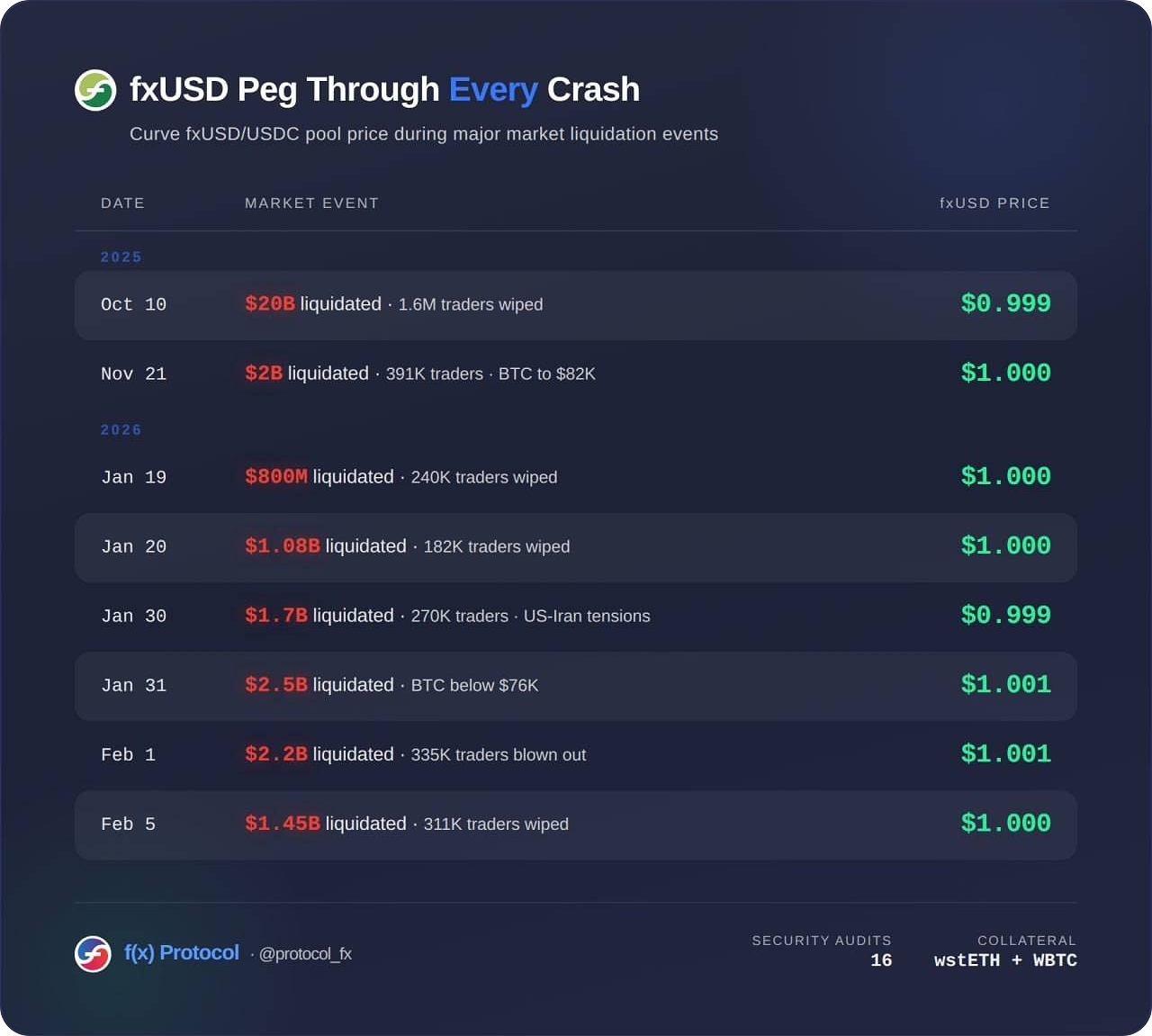
No. fxUSD has held within $0.999 to $1.001 through every major market crash since launch, including the October 2025 event where $20B was liquidated and 1.6M traders were wiped out. The peg has never broken. And the best part? It never required any human intervention.
What are the risks associated with fxUSD?
The fxUSD carries several risks that users should understand before investing. First, like all DeFi protocols, f(x) Protocol relies on smart contracts which, despite being audited, could contain vulnerabilities that put funds at risk. Second, fxUSD is backed by volatile assets like wstETH. In the event of an extreme and sudden market crash, the rebalancing mechanism and liquidation mechanism could both fail resulting in a lower collateralization of fxUSD. Finally, as a newer asset, fxUSD has lower liquidity than dominant stablecoins like USDT or USDC. As with any crypto asset, do your own research and evaluate your own risk.
Has f(x) Protocol been audited?
Yes. f(x) Protocol has undergone 16 audits by Trail of Bits, OpenZeppelin, and Secbit. Every line of production code has been reviewed. Audit reports are publicly available at fxprotocol.gitbook.io/audit-reports.
How is fxUSD regulated?
fxUSD is a decentralized, non-custodial stablecoin. It is not issued or backed by any regulated entity. The protocol operates via smart contracts on Ethereum, governed by a 6/9 multisig with a 3-day timelock. All collateral is verifiable on-chain at any time. Users should check their local regulations regarding crypto assets.
What happens to the fxUSD in case of a market crash?
fxUSD has proven its resilience through multiple major market crashes. During the October 2025 liquidation event ($20B liquidated, 1.6M traders wiped out in 24hours), fxUSD held at $0.999. Through January and February 2026 liquidation cascades ($1 to $2.5B per event), the peg stayed within $0.999 to $1.001. The protocol has five progressive peg protection mechanisms: organic position flow, Stability Pool arbitrage, temporary borrowing costs, emergency mode (never triggered in practice), and redemption at a $0.995 floor. Learn more at: fxprotocol.gitbook.io.